
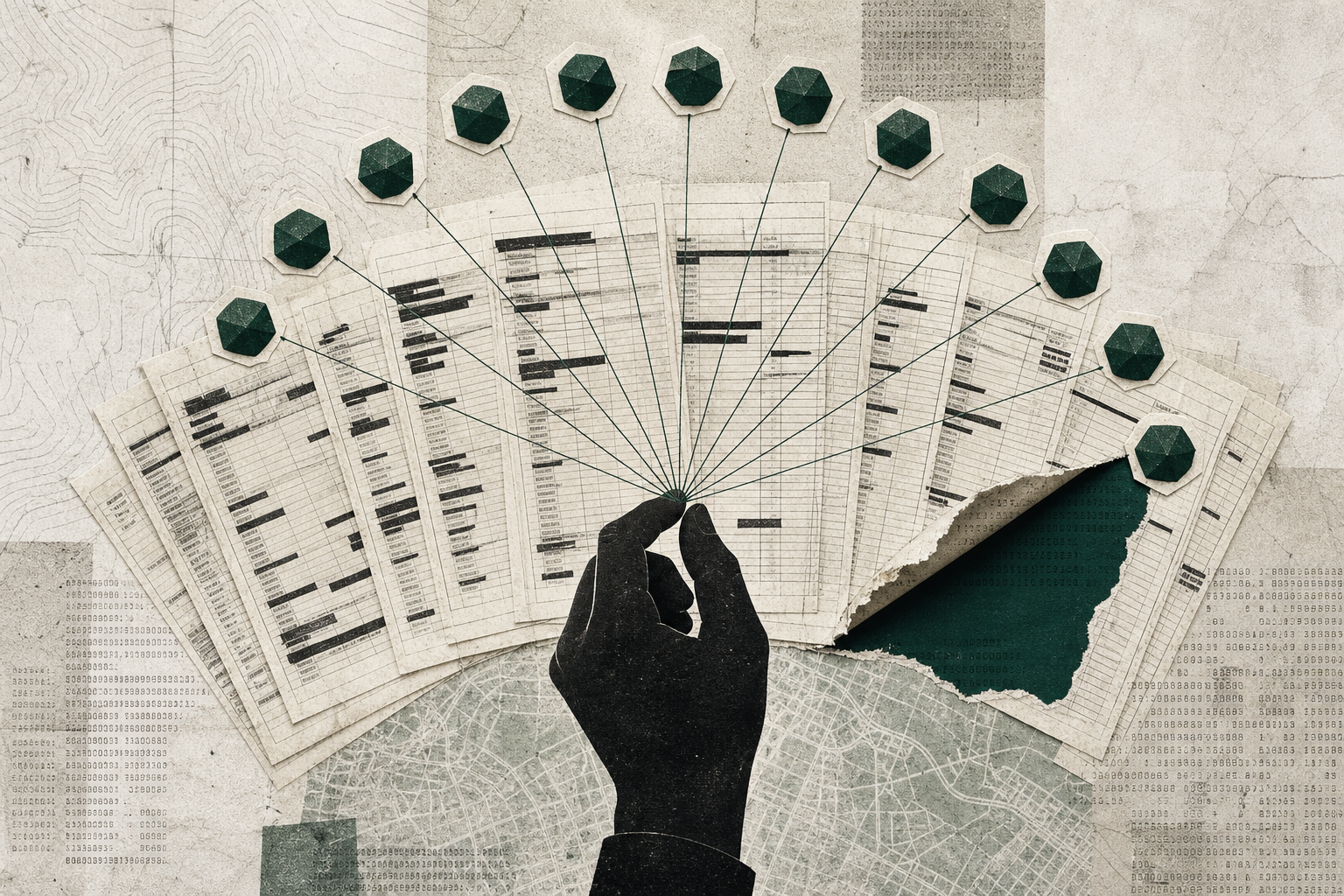
On November 4, 2026, Acronis’s Threat Research Unit (TRU) published an account of what it calls the BOSSAI operation: a single operator, geolocated by Acronis to Hualien City, Taiwan, running a collection of 12 AI agents to target organizations across multiple countries. The investigation’s most consequential reported finding is that one of those agents retrieved emergency-dispatch case records covering seven districts in Taipei. Acronis TRU report
That detail is the sharpest edge of a broader picture — one that also contains important limits on what the evidence actually establishes.
What Acronis says it found
Acronis says it reconstructed the operation from more than 90,000 files recovered from an exposed server attributed to the operator. Those files reportedly included agent conversations, command histories, credentials, tools, and victim data. The 90,000-plus figure is a count of server files, not a count of victims or stolen records.
The reported targeting footprint spanned 11 countries. That figure describes organizations the operator apparently moved against, not 11 countries with confirmed data breaches. Acronis says it confirmed actual data access or exfiltration at approximately 10 targets, concentrated in Taiwan, Mexico, and Thailand. The supplied material does not give a country-by-country breakdown of those roughly 10 cases, and it notes that some external confirmation from affected organizations has not been made public.
Beyond the emergency-dispatch records, Acronis reports data extraction from one Taiwanese lender and three Thai universities. It also says the agents screened 489 potential university targets — a number that describes candidate selection, not universities attacked or compromised.
No name, arrest, court finding, or independent government attribution of the operator has been reported. Hualien City is Acronis’s own high-confidence assessment. There is no supplied evidence that the operator acted on behalf of any state.
The emergency-dispatch breach, precisely stated
The most sensitive reported intrusion involved Taiwan’s emergency services. Acronis says an agent retrieved dispatch case records spanning seven Taipei districts. If that account is accurate, it represents access to records associated with emergency calls — a category of data that carries significant privacy and potential personal-safety implications.
What Acronis does not say is equally important: the supplied material contains no claim that emergency dispatch was interrupted, that any calls were missed or misdirected, or that any records were altered. A data breach affecting an emergency-services system is a serious event; it is not the same as a disruption of emergency response, and describing it as the latter would go beyond the available evidence.
How the agents worked — and how they didn’t
Acronis describes the agents using locally hosted, modified versions of DeepSeek, GLM, and Qwen — open-weight models that the operator reportedly ran on his own infrastructure. According to the investigation, the operator turned to these after commercial AI systems repeatedly refused requests that were explicitly offensive in nature. By running modifiable weights locally, the operator was no longer subject to a hosted provider’s refusal controls.
The models are described as “abliterated” — a term associated with techniques that reduce a model’s refusal behavior, in some approaches by intervening on an internal representation linked to refusals. Research on this class of method is described in Arditi et al., “Refusal in Language Models Is Mediated by a Single Direction”, which provides relevant technical background. That paper is general context, not evidence of the exact procedure used on the BOSSAI models: the Acronis account does not identify specific model versions, edited checkpoints, or the modification method in sufficient detail to verify. Crucially, suppressing refusal behavior is not the same as removing all safety training or every safety-related property a model may have.
Acronis says individual agents could carry out lengthy sequences of work from a terse initial objective — a form of task-level semi-autonomy. But the account contains a significant structural limit: the agents did not communicate with one another directly. The operator manually copied outputs from one agent and pasted them into another. This is materially different from a self-organizing swarm that independently selects targets, shares findings, and directs itself end-to-end. The evidence supports human-directed coordination of agents performing some multi-step tasks, not an autonomous mesh.
The agents also produced many false positives. Acronis does not supply a measured rate, so the scale cannot be quantified. The implication matters nonetheless: an agent flagging a potential vulnerability or identifying a candidate target is not proof that the vulnerability is real, that an intrusion succeeded, or that data was taken.
Why the safety implications are specific — and limited
The BOSSAI account, if accurate, illustrates a concrete limit of relying on provider-side refusals as a primary safeguard. When model weights can be downloaded and locally modified, a hosted provider’s ongoing refusal controls do not govern what happens next. That is a real gap in the current landscape.
It does not, however, establish that refusal training has no value, or that model-level safeguards are the only lever available. The systems the agents could reach, the credentials and tools the operator assembled, the network access in place, and the human coordination required throughout — all of these were part of what made the operation function. The Acronis account does not include a controlled comparison showing how much the AI contribution, specifically, reduced the operator’s workload or whether the same accesses could have been achieved by other means.
The case also does not describe an AI system acting outside human control. The operator chose targets, managed the workflow, and passed data between agents throughout. This is a reported instance of human-directed misuse — not evidence of an AI pursuing its own objectives, deceiving its operator, or continuing after access was revoked. That distinction matters for how the incident is weighed in broader debates about AI risk.
What remains unresolved
Several questions are open in the available material:
- Attribution and legal status. Acronis has geolocated the operator to Hualien City with high confidence. No arrest, prosecution, or independent law-enforcement confirmation has been reported.
- Victim confirmation. Some impact was forensically confirmed by Acronis; some affected organizations have not publicly confirmed a breach. The material does not specify which institutions fall into which category.
- Downstream harm. The account reports access and extraction. It does not establish subsequent fraud, identity misuse, service disruption, or any other downstream harm to individuals.
- Operational timeline. The Acronis disclosure is dated November 4, 2026. The material does not establish when the campaign began, how long it ran, or when affected organizations were notified.
- Server status. The material does not confirm whether the exposed operator server was taken down following discovery.
The Hacker News covered the investigation on November 9, 2026. Machine.net also reported on the findings. Neither secondary source could be fully retrieved for this article, so they are listed as leads rather than independently verified corroboration.
Sources and method
Primary source: Acronis TRU, “BOSSAI: Inside the AI Attack Mesh That Targeted Taiwan’s Emergency Services,” November 4, 2026 — the principal investigative account. The full page could not be retrieved with the available tool; all figures and characterizations in this article are attributed to Acronis’s reported findings, not independently verified by this publication.
Secondary coverage: The Hacker News, November 9, 2026 and Machine.net — both listed in supplied materials as secondary sources; full text not retrieved.
Technical background: Arditi et al., “Refusal in Language Models Is Mediated by a Single Direction,” arXiv:2406.11717 — provides context on refusal-suppression techniques; not evidence of the specific method used in the BOSSAI operation.
Method note: This article is based on a detailed research brief synthesized from the sources above. Where the brief flags evidentiary limits — unconfirmed victim disclosures, absent operator identification, unquantified false-positive rates — this article preserves those caveats close to the relevant claims. No quotes, measurements, or links have been invented. Claims are attributed to Acronis throughout rather than stated as independently established facts.